Corentis - AI checkpoint for regulated workflows
AI is moving from answers to actions.
McKinsey says 62% of surveyed organisations are at least experimenting with AI agents. Deloitte says worker access to AI rose by 50% in 2025, and companies expect more AI projects to move into production.
As more AI projects move into production, so do AI-related incidents. BCG reported that these incidents rose by 21% from 2024 to 2025.
In one 2025 EY survey of 975 large global companies, AI-related risks were associated with an estimated $4.3bn in losses across this sample alone.
This is the problem Corentis Shield is built for.
AI needs a checkpoint before it acts. Corentis provides it.
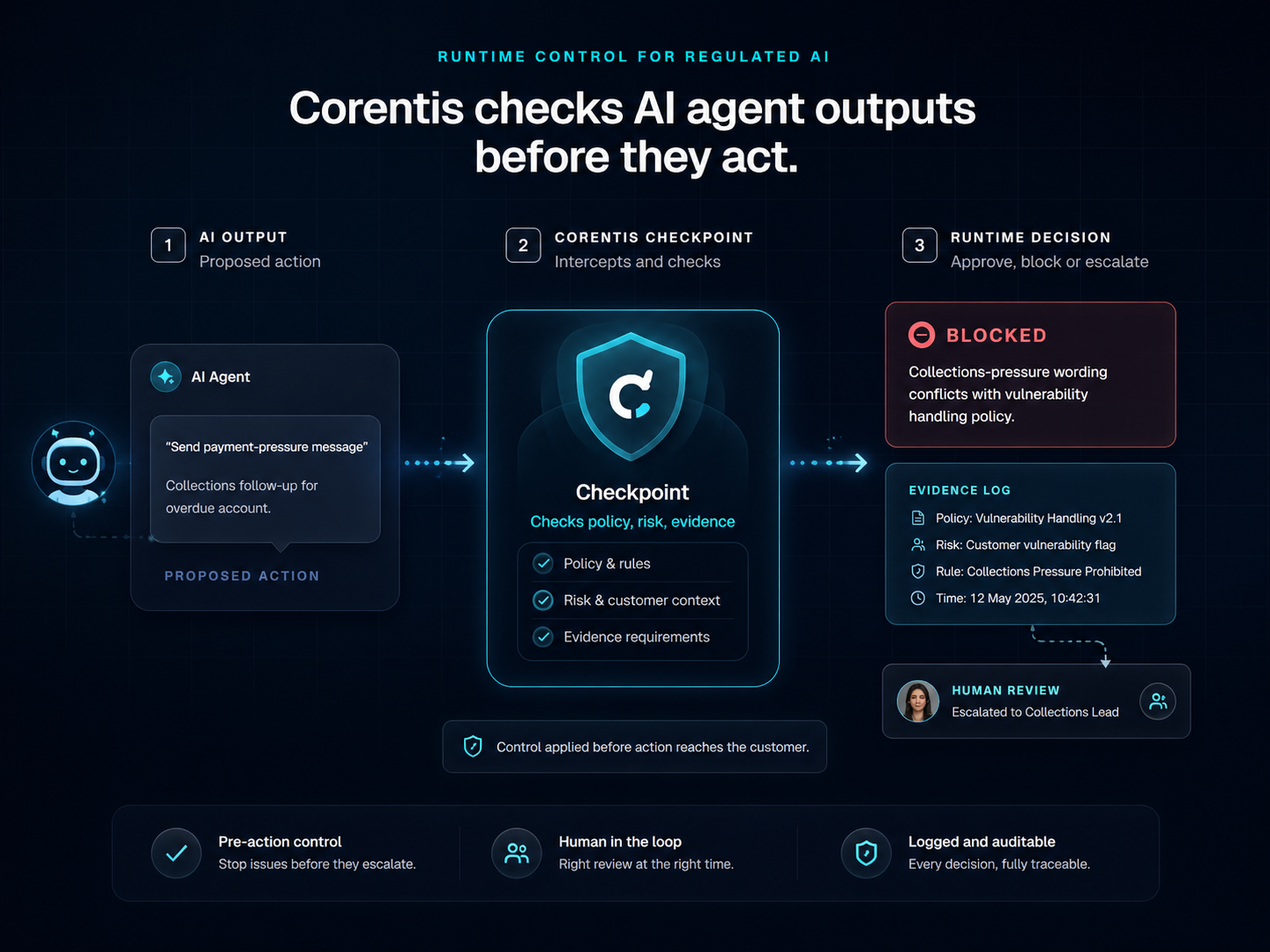
Corentis Shield checks AI outputs before they reach customers, teams or live systems - so sensitive actions can proceed, be reviewed, be escalated or be stopped with evidence recorded.
Corentis Shield
Checkpoint decision
AI output
Draft a standard payment-pressure message after a hardship disclosure.
Reason
Customer hardship disclosed. Collections-pressure wording conflicts with the configured vulnerability handling policy.
Next step
Human review and evidence capture.
Evidence
Checkpoint decision recorded in the Evidence Vault.
Every unchecked AI output can carry a commercial cost.
A risky AI reply is not just a bad answer if it reaches a customer. It can create rework, complaints, conduct risk and avoidable operational cost. Once AI outputs move into action, every mistake becomes more expensive to fix.

Replies, case notes and workflow steps need a checkpoint before they move forward.
a payment-pressure message sent to a vulnerable customer
a complaint closed without enough evidence
a CRM note added without review
a guidance response that drifts into advice
a workflow step triggered too soon
AI agent on its own vs AI agent with Corentis Shield
Without Corentis
- Policy lives in documents
- AI output may move too quickly
- Review points are unclear
- Evidence is gathered afterwards
- Escalation may be inconsistent
With Corentis Shield
- Policy becomes operational controls
- Sensitive actions pause before moving forward
- Human review is routed clearly
- Evidence is captured as the workflow runs
- Pilot reports become easier to produce
Why Corentis Shield?
Because teams need a simple checkpoint between an AI output and a real-world action.
Check the output
Draft replies, proposed actions and workflow updates are reviewed before they are used.
Review the context
Customer vulnerability, open complaints, risk signals and missing evidence can change what should happen next.
Route to people
Sensitive outputs can go to the right person before anything reaches the customer or system.
Record the evidence
Teams can see what was checked, why the decision was made and what evidence was missing.
Built for regulated workflows
Corentis starts where AI outputs can affect customers, records, decisions or regulated operations.
What Corentis Shield checks
The output. The context. The rules. The evidence.
The AI output
Draft messages, proposed actions or workflow updates.
The customer or case context
Risk signals, vulnerability, complaints, evidence and business rules.
The policy rules
Configured controls, approval rules and escalation points.
The evidence trail
What was checked, what decision was made, and why.
The checkpoint flow
Check before action. Review where it matters. Record the decision.
AI creates an output
Corentis Shield checks it
Policy, risk and evidence are reviewed
Proceed / Review / Escalate / Block
The decision is recorded
From policy to proof
A simple journey from governance intent to evidence people can inspect.
Policy
Checkpoint
Review
Evidence
Decision
Explore the launch-ready structure
These pages create the route from product explanation to proof, partner conversations and resource packs.
Why a checkpoint layer matters now
The problem is not simply whether organisations can use AI. It is whether they can control what AI is about to do before that action affects a customer, case or regulated workflow.
FCA complaints data
UK financial services firms received 1.85m complaints in 2025 H1.
This was a 3.6% increase from 2024 H2. Since 2021 H1, complaints have stayed relatively constant between 1.7m and 2.0m.
Financial Conduct Authority, 23 October 2025
McKinsey global AI survey
88% of respondents in McKinsey’s 2025 global survey reported regular AI use in at least one business function.
Only approximately one-third reported that their companies had begun scaling AI programmes.
McKinsey & Company, 5 November 2025
IBM / Ponemon
63% of breached organisations lacked AI governance policies to manage AI or prevent shadow AI.
IBM also reported that 97% of organisations with an AI-related security incident lacked proper AI access controls.
IBM / Ponemon Institute, 2025
From AI policy to proof of control
Corentis helps organisations move beyond policy documents and into operational assurance. It checks whether AI-assisted work follows defined controls, identifies when human review is required, blocks unsafe actions, and captures evidence that can be reviewed before deployment.
ControlBench UK
ControlBench UK is a strategic AI assurance dataset and evaluation harness for regulated AI agents. It brings together realistic workflow scenarios, policy-control checks, blocked-action tests, human-review gates and audit-ready evidence outputs.
Funding and sandbox readiness
Corentis is preparing for design-partner, sandbox and funding validation. Current work is focused on financial-services complaints, vulnerable-customer handling, AI-agent checkpointing, assurance datasets and evidence-backed human review.
More than a product: a route to trusted AI adoption
Corentis Shield starts as a checkpoint for AI outputs. The same mechanism can support pilots, assurance reports, benchmark datasets and live deployment across regulated workflows.
Practical assurance mechanism
Checks AI outputs before action and records what happened.
Pilot-ready path
Start with one workflow, test outputs and identify where human review is needed.
Commercial deployment route
Move from assurance review to API, SDK, webhook or private gateway.
Strategic asset potential
Build scenario libraries, expected decisions and benchmark reports.

Built for every stage of AI adoption
Explore
Find where unchecked AI outputs could create risk.
Test
Run realistic scenarios before live use.
Pilot
Apply Corentis Shield to one sensitive workflow.
Deploy
Connect through API, SDK, webhook or private gateway.
Scale
Expand across workflows and build evidence over time.
Clear outcomes before action
Corentis Shield gives teams a simple decision before an AI output reaches the real world.
Proceed
The output fits your rules.
Review
A person should check before the action continues.
Escalate
A specialist or supervisor should take over.
Block
The output conflicts with policy, risk or evidence requirements.
The next build phase.
Funding and design partnerships help turn the current prototype into deployable AI assurance infrastructure.
Start with one workflow.
You do not need to redesign every AI process on day one. Start with one sensitive workflow. Test the outputs. Find the review points. See where a checkpoint is needed before live use.
Corentis Shield
The checkpoint in action
AI output
Draft a standard payment-pressure message after a hardship disclosure.
Corentis Shield check
Policy, risk, customer context, evidence needs and approval rules are checked.
Required next step
Human review and evidence capture before any customer communication proceeds.
Evidence recorded
Decision, reason, policy version, timestamp and review status are recorded.
Reason
Customer hardship disclosed. Collections-pressure wording conflicts with the configured vulnerability handling policy.
Before you deploy an AI agent, test the checkpoint.
Start with one sensitive workflow. Corentis can help you test AI outputs, find where review is needed and see what evidence should be recorded before live use.
Building with design partners
Corentis is seeking early conversations with regulated teams, AI assurance stakeholders and strategic partners who want to test controlled AI workflows.